
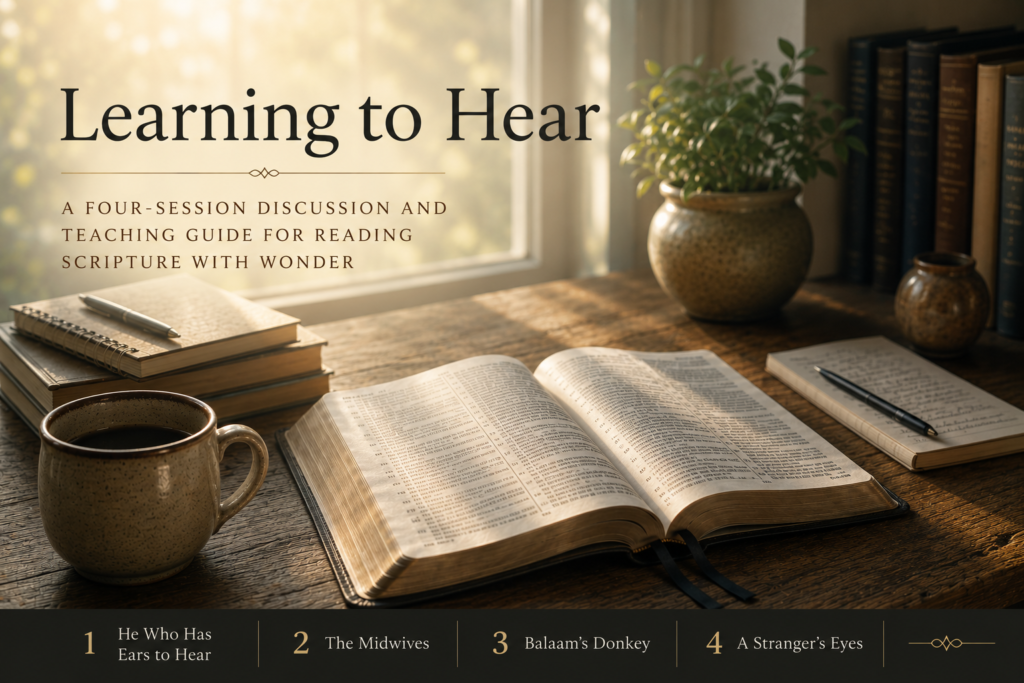
The passages selected for this series are intended as examples rather than comprehensive studies. Scripture is filled with details, patterns, literary contrasts, and surprising observations that reward attentive reading. These particular passages were chosen because they illustrate the habit of attentiveness in different ways. Readers and teachers are encouraged to continue practicing these same skills throughout the rest of Scripture.
The Central Question
A recurring question throughout this series will be:
What might the author want us to notice?
This question serves as the guiding thread for each session. Rather than beginning with interpretation or application, participants are encouraged to first observe the text carefully, noticing details, patterns, contrasts, repetitions, and questions that emerge naturally from the passage.
Attentiveness
For the purposes of this series, attentiveness means approaching Scripture slowly enough to notice what the text is actually doing before rushing to interpretation or application.
Application remains important, but attentive reading begins with observation. Before asking what a passage means to us, we first seek to understand what the author is communicating.
Series Goal
The goal of this series is not mastery of particular passages, but the development of habits that help readers engage Scripture more attentively.
Modern readers often move quickly through the biblical text, eager to reach conclusions, applications, or the next chapter. While there is value in broad familiarity with Scripture, there is also value in slowing down and dwelling within a passage long enough to notice its details, questions, tensions, and surprises.
These sessions are intended to encourage a form of reading that inhabits the biblical story rather than merely passing through it. By learning to notice what the authors emphasize, repeat, contrast, or leave unexplained, readers may discover dimensions of familiar passages that previously went unnoticed.
The hope is not simply greater knowledge, but a deeper appreciation for the richness, wonder, and theological depth already present within Scripture.
Attentive reading is not an end in itself. The purpose of noticing more is to experience more—to inhabit the biblical story more fully, to dwell with its questions longer, and to recover the sense of wonder that familiarity can sometimes obscure. The goal is not merely to understand Scripture better, but to allow Scripture to shape us through attentiveness, humility, and curiosity.
Session 1: He Who Has Ears to Hear
Overview
The central theme of this opening session is Jesus’ recurring invitation:
“Whoever has ears to hear, let them hear.”
This phrase appears throughout the New Testament (Mark 4:9, Matthew 11:15, Matthew 13:9, Revelation 2:7, and elsewhere) and serves as an invitation to attentiveness. Jesus is not speaking merely of hearing words, but of perceiving what those words reveal.
This series explores that same idea through a collection of biblical passages that reward careful reading. The goal is not to uncover hidden meanings, but to cultivate the habit of noticing what is already present in the text.
The purpose of this attentiveness is not merely greater understanding, but a deeper engagement with the biblical story itself.
A recurring question throughout the series will be:
What might the author want us to notice?
Session Objective
By the end of this session, participants should recognize that:
- Knowing biblical facts and inhabiting the biblical story are not always the same thing.
- Scripture often communicates through details, contrasts, and literary choices that are easy to overlook.
- Attentiveness is a skill that can be practiced and developed.
- Asking “What might the author want us to notice?” can open new avenues of understanding.
Primary Text
- Genesis 50:22–26
- Exodus 1:1–10
Central Theme
Attentive reading often reveals dimensions of familiar texts that are easy to overlook. Learning to hear begins with learning to notice.
Teaching Focus
The transition between Genesis and Exodus provides a useful example of attentive reading.
Many readers know that centuries pass between the death of Joseph and the birth of Moses. Yet when the passages are read consecutively, the narrative moves so quickly that the passage of time can easily be overlooked.
The purpose of this exercise is not to emphasize chronology for its own sake, but to demonstrate how slowing down and observing the text can change the way a familiar story is understood.
Particular attention should be given to what the passing of generations means for the people of Israel. The family that entered Egypt with Joseph has become a nation. Memories have faded. Circumstances have changed. A new Pharaoh has arisen who knows nothing of Joseph.
This context may also influence how readers understand God’s later words to Moses and to Israel. Statements such as, “I will take you to be my people, and I will be your God,” may sound different when read against the backdrop of centuries spent in Egypt. The question is not whether Israel remained descended from Abraham, Isaac, and Jacob, but how the passage of time shapes the reader’s understanding of Israel’s relationship with God and of God’s faithfulness to His promises.
Questions for Attentive Reading
- What stands out when these passages are read together?
- What details are repeated?
- What has changed since the end of Genesis?
- What seems to have remained the same?
- What questions does the text naturally raise?
- What would have to happen for this situation to exist?
- What might the author want us to notice?
Closing Reflection
Attentiveness is not primarily the search for hidden meanings. It is the discipline of noticing what is already present in the text.
The next time you read Scripture, ask:
What might the author want me to notice?
Session 2: The Midwives
Overview
This session explores the story of Shiphrah and Puah, two Hebrew midwives who appear briefly at the beginning of Exodus.
At first glance, the passage seems straightforward: Pharaoh commands the midwives to kill Hebrew male children, and the midwives refuse. Yet a closer reading reveals details that raise interesting questions. Why does Pharaoh speak directly to the midwives? Why are they named? Why does Pharaoh remain unnamed? Why does Scripture preserve this story at all?
As in the previous session, the goal is not merely to understand what happened, but to cultivate the habit of noticing what the text may be drawing our attention toward.
Session Objective
By the end of this session, participants should recognize that:
- Scripture often directs attention toward people who might otherwise be overlooked.
- The details preserved by a biblical author are rarely accidental.
- Observation often precedes interpretation.
- Asking “What might the author want us to notice?” can reveal surprising dimensions of familiar stories.
Primary Text
Exodus 1:15–21
Central Theme
God’s story often focuses on different people than the world does.
Teaching Focus
The story of the Hebrew midwives occurs during a period of growing tension between Egypt and Israel. Pharaoh, concerned by Israel’s increasing numbers, attempts to suppress the Hebrew population through increasingly severe measures.
Particular attention should be given to the repeated statement that the midwives “feared God.” The text does not explain how much they knew, how they understood God, or what role they believed they were playing within Israel’s story. It simply presents their fear of God as the reason for their actions.
Readers may wish to consider what this detail contributes to the larger narrative of Exodus. After centuries in Egypt, what does the presence of God-fearing individuals suggest about Israel’s relationship with God? Is the author providing a clue, however small, that the knowledge of God had not entirely disappeared?
The text does not answer these questions directly. Yet asking them may help readers appreciate the significance of details that are easily overlooked in familiar passages.
The narrative also directs attention toward two women who occupy a seemingly insignificant position within Egyptian society. The author preserves their names—Shiphrah and Puah—while the identity of Pharaoh himself remains unstated.
Teachers may wish to explore why the author chooses to tell the story in this manner. The passage invites readers to consider not only the actions of the midwives, but also the literary contrasts present within the narrative.
Questions for Attentive Reading
- Why does Pharaoh speak directly to the midwives?
- Why are the midwives named?
- Why is Pharaoh not named?
- What details does the author emphasize?
- What details are left unexplained?
- What questions does this passage leave unanswered?
- Why does the author preserve this story?
- What does it mean that the midwives “feared God”?
- What might the author want us to notice?
Closing Reflection
History often remembers kings, rulers, and powerful people. Scripture frequently remembers different people.
In this story, the most powerful man in Egypt remains unnamed, while two Hebrew midwives are remembered by name thousands of years later.
The passage offers no explicit explanation for this contrast. Yet it invites readers to consider what the biblical authors regarded as worthy of remembrance, and whether faithfulness may matter more than status, power, or position.
As you continue reading Scripture, ask:
What might the author want me to notice?
Session 3: Balaam’s Donkey
Overview
This session explores one of the most unusual stories in Scripture: Balaam and his donkey.
Many readers remember the talking donkey but pay little attention to the events leading up to that moment. Yet the narrative carefully establishes Balaam as someone sought out for spiritual insight. Kings send emissaries to him. Rewards are offered. His blessings and curses are treated as matters of consequence.
As in previous sessions, the goal is not merely to understand what happened, but to slow down long enough to experience the story as it unfolds and to consider what the author may be drawing our attention toward.
Session Objective
By the end of this session, participants should recognize that:
- The way a character is introduced can shape how we understand the story that follows.
- Biblical narratives often use irony to communicate meaning.
- Reading attentively can reveal dimensions of a story that are easy to overlook when focusing only on major events.
- Asking “What might the author want us to notice?” can deepen our experience of familiar passages.
Primary Text
Numbers 22–24
Central Theme
Attentive readers learn to notice how a story is told, not merely what happens.
Teaching Focus
Many readers encounter the story of Balaam as a tale about a talking donkey. Yet before the donkey ever speaks, the narrative spends considerable time establishing Balaam’s role within the story.
Balak sends messengers to Balaam, offers rewards, and persists even after an initial refusal. These details suggest that Balaam is regarded as someone whose words carry weight. The reader is led to expect a man capable of perceiving spiritual realities.
Against this backdrop, the encounter with the angel takes on a different character. The donkey sees what Balaam cannot. Three times the animal responds appropriately to a danger invisible to its master. The tension builds as the reader understands what Balaam does not.
Attentive readers may notice the irony that runs throughout the account. The one expected to see is blind, while the one least expected to see perceives the truth immediately.
Whether the story is read as humor, irony, warning, or all three, the experience changes when the reader slows down and allows the narrative to establish its characters before rushing ahead to the most memorable event.
Questions for Attentive Reading
- What details does the story provide about Balaam before the donkey appears?
- Why does Balak seek Balaam’s help?
- What expectations does the narrative create about Balaam?
- What details does the reader know that Balaam does not?
- Why might the author tell the story this way?
- Why does Balaam seem less surprised by the talking donkey than many modern readers?
- What role does irony play in the story?
- What might the author want us to notice?
Closing Reflection
The story of Balaam is often remembered because a donkey speaks. Yet attentive readers may discover that the heart of the story lies elsewhere.
The narrative invites us to experience the irony of a man known for spiritual insight failing to see what is directly before him. The donkey becomes memorable not merely because it speaks, but because it sees.
As you continue reading Scripture, consider not only what happens in a story, but how the story is told.
What might the author want me to notice?
Session 4: A Stranger’s Eyes
Overview
The previous sessions have focused primarily on observing details within the text: noticing context, emphasis, questions, and irony. This session takes a different approach.
Rather than focusing on a particular detail, readers are invited to consider a familiar event from an unfamiliar perspective. By borrowing the perspective of a first-time visitor to Jerusalem, the goal is not to add information to the text, but to recover a sense of wonder that familiarity can sometimes diminish.
Many biblical stories become so familiar that their significance is easily overlooked. We know what happens before we begin reading. We know the characters. We know the outcome. Yet familiarity can sometimes prevent us from experiencing the astonishment that the original audience may have felt.
This session explores the dedication of Solomon’s Temple and invites readers to ask what it might have been like to witness such an event for the very first time.
Session Objective
By the end of this session, participants should recognize that:
- Familiarity can diminish a sense of wonder.
- Perspective can influence how a passage is experienced.
- Attentive reading involves more than observation; it also involves entering the world of the text.
- Scripture is not merely a collection of facts to be understood, but a story to be inhabited.
Primary Text
1 Kings 8:10–11
2 Chronicles 5:13–14
Central Theme
Attentive reading can help us recover the wonder of familiar passages.
Teaching Focus
The dedication of Solomon’s Temple records one of the most remarkable moments in Israel’s history. As the priests complete their service, the glory of the LORD fills the Temple so completely that they are unable to continue ministering.
Most readers understand the significance of this event. Yet understanding and experiencing are not always the same thing.
One challenge of reading familiar passages is that repeated exposure can lessen their impact. Events that would astonish us if encountered for the first time can gradually become ordinary through familiarity.
The exercise that follows is not intended as a historical reconstruction. Rather, it is an attempt to view a familiar event through unfamiliar eyes. By borrowing the perspective of a first-time visitor to Jerusalem, readers are invited to consider how they might have experienced the dedication of the Temple had they witnessed it themselves.
The goal is not to imagine details absent from the text, but to recover the weight of details already present. The priests cannot stand. The Temple is filled with glory. The presence of God is manifest among His people.
Readers are encouraged to linger within the scene long enough to experience its wonder. To hear the sounds of the city, to witness the sudden stillness that follows, and to imagine what it might have felt like to stand among those who saw the glory fill the Temple for the first time.
Attentive readers may discover that the passage communicates more than information. It invites awe.
A Stranger’s Eyes
To see the Temple as a stranger sees it reminds us that presence was never meant to feel ordinary.
Imagine being an outsider and arriving in Jerusalem for the first time. The city is bustling, pilgrims climbing its slopes, songs rising in unfamiliar cadences. At the center stands the Temple, gleaming stone, towering walls, priests moving in ordered rhythm. You have seen shrines before, altars smoking to gods of wood and bronze. You have heard the stories, but expect more of the same.
And then it happens. A radiant glory floods the courts, light spilling outward, thick and luminous, impossible to mistake. The air feels heavy, charged, alive. The priests stagger and fall, unable to stand. The songs falter into silence and tears. You do not understand the language, but you cannot mistake what you see. This house is filled, not with incense or fire, but with the very presence of the God of Israel.
What surprises you even more is the people’s response. Shock, yes, but also joy, recognition, awe that feels practiced, like a long-forgotten truth suddenly remembered. They have seen wonders before. They know the stories. This moment feels to them less like something new and more like something returning.
You will go home and tell the story. You will say that you saw glory itself fill a house of stone. They will laugh. They will say you dreamed it, or drank too much wine, or were carried away by the crowd. You will never convince them. But you will know.
For the pilgrim, to borrow the stranger’s eyes is to recover the wonder Israel itself too often forgot. Presence is not ordinary. It is not tame. It is the God of creation choosing to dwell on earth, filling a house of stone with uncontainable glory.
Questions for Attentive Reading
- What details in the text contribute to the sense of awe surrounding this event?
- What would it have been like to witness this event for the first time?
- How might a foreign visitor have understood what was happening?
- What assumptions do modern readers bring to this passage?
- What has become familiar that should still astonish us?
- How does perspective influence the way we experience a story?
- What might the author want us to notice?
Closing Reflection
The purpose of attentive reading is not merely to notice more.
It is to experience more.
The dedication of the Temple records an event that should evoke wonder. Yet wonder can be difficult to sustain when a story becomes familiar.
Sometimes the most helpful thing a reader can do is step outside the story they think they know and encounter it again with fresh eyes.
As you continue reading Scripture, consider not only what the text says, but how it invites you to experience the world it describes.
What might the author want me to notice?
Conclusion: He Who Has Ears to Hear
We began with an invitation.
Whoever has ears to hear, let them hear.
Jesus said this repeatedly — after parables, after visions, after words that left even his closest followers wondering. It is not a demand for better comprehension. It is a call to a different kind of attention. To hear, in this sense, is to be genuinely present with what is being said.
That is what these sessions have been about.
We practiced seeing context — discovering that centuries of silence stand between Joseph’s last words and the birth of Moses, and that the silence changes everything.
We practiced noticing who the story remembers — two women named while a Pharaoh goes unnamed, and the quiet question that leaves behind: what does God regard as worth remembering?
We practiced reading irony — watching a man famous for spiritual sight fail to see what his donkey could not miss, and feeling the humor and the warning at the same time.
We practiced recovering wonder — stepping into the Temple dedication through a stranger’s eyes, standing in a crowd that cannot quite believe what it is witnessing, and realizing that the weight of that moment has never actually diminished.
Along the way, we discovered that hearing often begins with seeing.
Seeing context. Seeing details. Seeing irony. Seeing familiar stories as if for the first time.
Some of the questions we raised were answered. Others were not. And that is not a failure of attentive reading — it is what attentive reading looks like. Scripture was not written to resolve every question but to draw us into ongoing encounter with the God who speaks through it.
The goal was never mastery. It was presence.
So as you return to Scripture — whether tomorrow or next week or in a quiet moment you did not expect — carry the question with you:
What might the author want us to notice?